|
Summary -
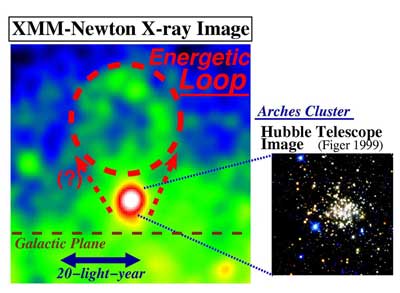
(Apr 8, 2005) A vast looping structure
20 light-years across has been discovered near the heart
of the Milky Way. The loop was found near a star forming
region of our galaxy in the X-ray spectrum using the
European Space Agency's XMM-Newton space telescope. Very
high energy particles, usually only seen coming from
pulsars or supernovae remnants, are streaming out of the
object, so it could be working as a kind of natural
particle accelerator.
Full Story -
Astronomers
have found a vast loop-like structure, 20 light years
across, adjacent to the most massive star-forming region
known in our galaxy. The loop, which was observed in
X-ray wavelengths, is 15 times the size of the Arches
Cluster, a star-forming region close to the centre of
the Milky Way. This is the first time that such a
distinctive and huge loop structure has been observed.
Dr Masaaki Sakano, from the University of Leicester,
will be presenting the discovery at the RAS National
Astronomy Meeting at the University of Birmingham on
Friday 8th April.
The team of astronomers, which includes scientists from
the University of Leicester, CEA Saclay and the Max
Planke Institute for Extraterrestrial Physics, observed
the Arches Cluster repeatedly using the European X-ray
satellite, XMM-Newton, as a part of the XMM-Newton
Galactic Centre Survey. The galactic centre can only be
observed at certain wavelengths, such as X-rays, because
large amounts of dust lie in our line of sight and this
blocks out optical light.
Dr Sakano says, "The X-ray spectrum of the loop is
extraordinary. Most diffuse X-ray sources in the
Universe have a characteristic temperature because they
are the residual radiation from an event, such as a
supernova explosion. However in this case the loop is
non-thermal and this means that whatever the origin of
the structure is, it is not stationary but rather the
result of some ongoing process."
The most straightforward interpretation of the
observations is that powerful particle-acceleration is
occurring on-site, producing high energy particles with
an energy of up to a thousand trillion electron volts (a
thousand times more energetic than those produced in
man-made particle accelerators). Such particles have
been detected previously in a few supernova remnants and
many pulsar nebulae, where a very powerful central
source has created them. However, evidence for
high-energy particles has never been observed before in
star-forming regions of our galaxy.
At this stage it is not clear whether the loop structure
is physically related to the Arches Cluster or just
happens to be in our line of sight. However, if future
observations show that the Arches Cluster is responsible
for the feature, this discovery suggests that
star-forming activity plays an important role in the
energetic Universe.
Original Source: RAS
News Release |